25 May 2016

Outings Report - May 2016


Young’s Property at Hampton   (Report by Jean and Ben Gundry, and Francis Mangubhai)


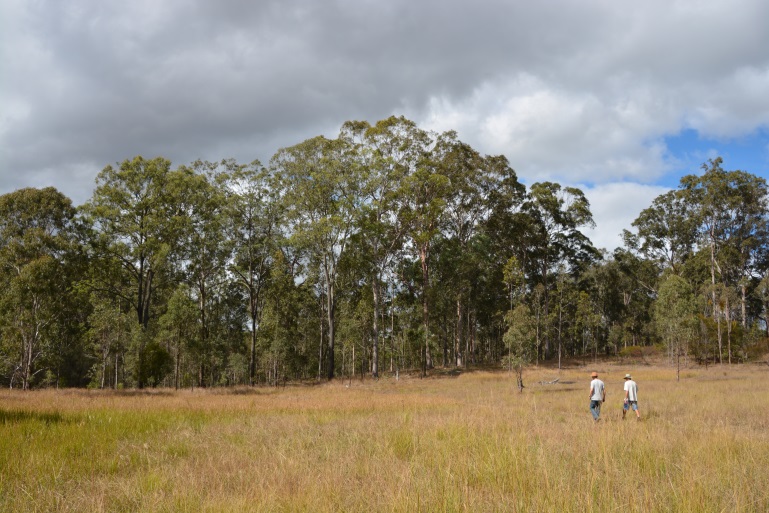
Twenty Toowoomba Field Naturalists spent a fine Mothers’ Day at Peter and Margie Young’s 40 acre retreat, nestled just off the highway a little east of Hampton. This is an elongated, east/west aligned block in ridge and creek country (Perseverance catchment), so it takes in a fair variety of topography.
Peter is the Land for Wildlife Co-ordinator for Brisbane City Council and says their purchase of this block five years ago was motivated by an ultimate retirement plan and a chance to put into effect the principles from his own workplace of saving and regenerating our bushland environment.
The original subdivision was intended to be a working farm and the timber was largely cleared, therefore what we see today is maturing regrowth. There are few habitat trees with hollows, so Peter has sited nest-boxes which have attracted residents in the form of owlet nightjars, microbats, brushtail possums and, he suspects, gliders. Interestingly, an antechinus family has taken more of a liking to nesting on a shelf in their hut. The property has not been grazed for many years, though the Youngs receive occasional visits from two horses or a cow, via an opportune weak point in the fence across this creek. Even in these current dry conditions the long grasses gave evidence of this no/low grazing regime.

 Left: neighbour's property 
(grazed by horses). Right: Young's property with no grazing (photos: F. Mangubhai)


Of note is that Peter has occasionally seen a dingo, but no foxes or feral cats. He believes the dingo has kept these other predators away – therefore the smaller native creatures are having a better chance here. (Echidnas, dunnarts, antechinus, bandicoots, wallabies etc.). Goannas, water and bearded dragons are the usual reptiles, while five species of frog have been identified by call.
Our group arrived a little ahead of our scheduled 9.00am and it was a great pleasure to catch up with Garth and Mary Hockly, “almost” neighbours of Peter and Margie who live a few kilometres further down the road, and who are long time TFNC members.
The main walk was down to the creek, to the eastern and lower end of the property. This took us through a patch of she oaks (Casuarina littoralis) in a little gully where Peter immediately located some “orts” – chewed-up cone matter that is discarded by the glossy black cockatoos, which, unfortunately, we did not see on the day.


Tallowwood (Eucalyptus microcorys)

Walk to the Casuarina gully
 (Both photos above by Jean Gundry)


Above the she oaks, we found our way to the fence line, where Tallowoods (E.microcorys) and Ironbarks (E. crebra) were the dominant trees, with Red ash (Alphitonia excelsa) and others providing the mid canopy. The understorey in this open forest provided particular interest as it was tangibly at our level: Maytenus silvestris (Narrow-leaf Orangebark), Notalaea sp. ( Mock Olive), Eremophila debilis (Winter Apple) Leucopogon sp. – perhaps L.mitchellii ( Whitebeard), Breynia oblongifolia (Coffee Bush), Hakea florulenta (Clothes-peg hakea), Cassinia laevis (Cough Bush -rice paper type of flower) Pisonia aculeate ( Thorny pisonia), Bursaria sp., Cryptocarya sp.
At the creek, we could see the evidence of Peter’s five-year battle with his privet invaders. Once almost impenetrable at this site, it is now an open environment above the waterhole again. In the 2011 floods, the side creek course was laid totally bare, with lots of rocks being redistributed from upstream. Lomandra longifolia were the first new colonizers and are still the dominant occupiers, but now others are becoming established for example Hovea longipes (Long-stalked hovea), Eustrephus latifolius (Wombat Berry), and Plectanthrus sp.
Our second shorter walk, after an unhurried Morning Tea, took us to a ridge-top perhaps exclusively occupied by Corymbia maculata (Spotted Gum) – clean-barked but dimpled and majestic. At ground level, we saw Hardenbergia violacea and Maytenus bilocularus, and Peter reported that he has seen donkey and hyacinth orchids at one location in this little zone.

Peter Young and Ben Gundry with the ridge of Spotted Gums (photo: Jean Gundry)

Peter then concluded with his Regeneration Project where he has been applying Jack Mitchell’s Forest Farming principles, as developed in coastal areas to the north of Brisbane. However, this hasn’t been totally successful here because of greater frost incidence. The principle is to plant some rows of pioneer species such as Acacia melanoxylon (Blackwood or Black Wattle) and Lophostemon confertus (Brush Box) in alternate rows, to pro-vide protection for more valued but slower growing species, such as: Toona ciliate ( Red Cedar -doing very well so far), Grevillea robusta (Silky Oak), Melia azedarach (White Cedar), Flindersia australis (Crows Ash), Araucaria cunninghamii (Hoop Pine), Castanospermum australe (Black Bean), Gmelina leichardtii (White Beech). Deer and wallabies present a challenge to this experimental planting.


Bird List (compiled by Trish Allen)
Birds seen: Pied Butcherbird, Noisy Miner, Brown Honeyeater, Weebill, Red-browed Finch.
Birds heard but not seen: Eastern Yellow Robin, Currawong, White-throated Treecreeper, Grey Fantail.

Speaker's Report: May 2016 meeting


Travels in the South-West Corner of Australia   ( Report by Jean Gundry and Cheryl Haxen)


Ben and Jean travelled by road in August/September 2014 to WA via the Eyre Peninsula and the Nullarbor to the South-West corner of Western Australia, also known as the SW Botanical Province. Their journey took in areas of heath and shrub land vegetation in the Kwongan, a distinct and interesting vegetation zone and included visits to Cape le Grande National Park (N.P.), Fitzgerald River N.P. and the Stirling Range N.P. A farm-sit near Ongerup afforded time to explore the incredibly rich flora of the region.
The entire area forms part of the Yilgarn Craton, a huge and ancient chunk of granite rock formed 3700 -2400 million years ago. Over time the granite has eroded to deep infertile sands and the remaining outcrops, granite inselbergs, continue to crack and flake, and damp soak areas form in pockets creating an environment for a rich and diverse vegetation ecosystem. In addition, 40 million years ago the sea level was 250 metres higher than today resulting in the area being isolated for a considerable time.  This isolation resulted in the evolution of many endemic species of plants. To date 8,500 species have been identified.
Harsh conditions have resulted in hardy species with adaptations for water saving and coping with the nutrient poor soils. Jean showed photographs from a number of vegetation types: the Myrtaceous –proteaceous shrublands, Coastal shrubland on granite, Banksia woodlands, Wodjil thickets, Swamp and Sedge Kwongan and the Stirling Sandstone Kwongan. As in South Africa, the Hakeas are richly represented with examples including Hakea clavata with thick succulent leaves ending in a protective spike and Hakea drupacea (sweet hakea) with needle-like leaves. In contrast she showed Utricularia menziesii (red bladderwort), a carnivorous plant of damp areas. The roots bear minute bladders which expand rapidly when triggered by movement in the water and suck in small aquatic creatures which are digested, providing the nutrients lacking in waterlogged soils. Parasitic plants such as Santalum (Quandongs) and Nuytsia (Christmas tree) have an alternative nutrient-acquisition strategy but are under-represented due to inherent risks such as dehydration and fire. 
Most plants in the nutrient-poor soils of the Kwongan have non-mycorrhizal roots termed cluster roots, dense outgrowths which are designed to release carboxylates which enable the uptake of scarce phosphorus. This includes members of the Proteacaea Family which are richly represented here. One exception, Hakea verrucosa (Wheel Hakea) has mycorrhizal associations. Jean also had a number of photographs of plants in the Fabaceae (pea and bean family). Many of this family and others in these harsh environments produce toxins to discourage too much damage by herbivores. Domestic livestock is often affected but native animals have evolved resistance.
Australia is generally special in having such a large number of plants pollinated by animals other than insects, and this meant that Jean and Ben enjoyed spectacular birdwatching – Western spinebills and New Holland honeyeaters feeding on Lambertia, Leptospermum, Lechenaultia etcetera. Dryandra dallanneyi (couch honey-pot) is an exception, it flowers at ground level and is pollinated by honey possums.
There are also problem ferals like cats and even kookaburras which are an introduced species here. However much of interest remains including Carnaby’s cockatoos, Red-tailed and Baudin’s long-billed cockatoos, Elegant parrots, Purple-crowned lorikeets, Mallee fowl, bandicoots, shingleback lizards, Rosenberg’s goanna and the Spotted Thigh frog (Littoria cyclorhyncha) endemic to the area.
WA is very rich in orchids, a highly evolved family of plants most commonly pollinated by insects. A significant number of ground orchids was photographed and Jean had managed to identify most of them. Beautiful shots of cowslip, slipper, wasp, bee and mantis orchids were shown, the last three resembling the insects for which they are commonly named. Some of these resemblances are no accident as they have evolved to attract specific insects to pollinate them sometimes by mimicking the female insect which causes the male to attempt to mate, thereby collecting pollen and transferring it to the next flower he tries to mate with. There were greenhood orchids which trap insects briefly in order to effect pollination. There is only one species known of the sugar orchid (Ericksonella sacharata) which is endemic to just a small region. It smells strongly of musky sweet cinnamon. The stunning sun orchid Eastern Queen of Sheba (Thelmitra aff. Variegata) is a widespread but infrequent inhabitant of the sand heath.
Along the way they discovered individuals and families involved with conservation of these unique habitats and plants. Near Stirling Range NP large areas were cleared post-war of what were considered worthless plants. A million acres a year was the goal. The result was erosion and salinity and there is now remediation in progress, carried out by a growing number of concerned landowners and conservation groups including Bob Brown’s Bush Heritage. Hans Lambers and the team at UWA are working hard on a bid to have the entire Kwongan area World Heritage listed, but with considerable intransigence from the current State government. Thanks to Jean for the wonderful photographs and the many hours of research which made the presentation of such varied interest.

Ben and Jean travelled by road in August/September 2014 to WA via the Eyre Peninsula and the Nullarbor to the South-West corner of Western Australia, also known as the SW Botanical Province. Their journey took in areas of heath and shrub land vegetation in the Kwongan, a distinct and interesting vegetation zone and included visits to Cape le Grande National Park (N.P.), Fitzgerald River N.P. and the Stirling Range N.P. A farm-sit near Ongerup afforded time to explore the incredibly rich flora of the region.
The entire area forms part of the Yilgarn Craton, a huge and ancient chunk of granite rock formed 3700 -2400 million years ago. Over time the granite has eroded to deep infertile sands and the remaining outcrops, granite inselbergs, continue to crack and flake, and damp soak areas form in pockets creating an environment for a rich and diverse vegetation ecosystem. In addition, 40 million years ago the sea level was 250 metres higher than today resulting in the area being isolated for a considerable time.  This isolation resulted in the evolution of many endemic species of plants. To date 8,500 species have been identified.
Harsh conditions have resulted in hardy species with adaptations for water saving and coping with the nutrient poor soils. Jean showed photographs from a number of vegetation types: the Myrtaceous –proteaceous shrublands, Coastal shrubland on granite, Banksia woodlands, Wodjil thickets, Swamp and Sedge Kwongan and the Stirling Sandstone Kwongan. As in South Africa, the Hakeas are richly represented with examples including Hakea clavata with thick succulent leaves ending in a protective spike and Hakea drupacea (sweet hakea) with needle-like leaves. In contrast she showed Utricularia menziesii (red bladderwort), a carnivorous plant of damp areas. The roots bear minute bladders which expand rapidly when triggered by movement in the water and suck in small aquatic creatures which are digested, providing the nutrients lacking in waterlogged soils. Parasitic plants such as Santalum (Quandongs) and Nuytsia (Christmas tree) have an alternative nutrient-acquisition strategy but are under-represented due to inherent risks such as dehydration and fire. 
Most plants in the nutrient-poor soils of the Kwongan have non-mycorrhizal roots termed cluster roots, dense outgrowths which are designed to release carboxylates which enable the uptake of scarce phosphorus. This includes members of the Proteacaea Family which are richly represented here. One exception, Hakea verrucosa (Wheel Hakea) has mycorrhizal associations. Jean also had a number of photographs of plants in the Fabaceae (pea and bean family). Many of this family and others in these harsh environments produce toxins to discourage too much damage by herbivores. Domestic livestock is often affected but native animals have evolved resistance.
Australia is generally special in having such a large number of plants pollinated by animals other than insects, and this meant that Jean and Ben enjoyed spectacular birdwatching – Western spinebills and New Holland honeyeaters feeding on Lambertia, Leptospermum, Lechenaultia etcetera. Dryandra dallanneyi (couch honey-pot) is an exception, it flowers at ground level and is pollinated by honey possums.
There are also problem ferals like cats and even kookaburras which are an introduced species here. However much of interest remains including Carnaby’s cockatoos, Red-tailed and Baudin’s long-billed cockatoos, Elegant parrots, Purple-crowned lorikeets, Mallee fowl, bandicoots, shingleback lizards, Rosenberg’s goanna and the Spotted Thigh frog (Littoria cyclorhyncha) endemic to the area.
WA is very rich in orchids, a highly evolved family of plants most commonly pollinated by insects. A significant number of ground orchids was photographed and Jean had managed to identify most of them. Beautiful shots of cowslip, slipper, wasp, bee and mantis orchids were shown, the last three resembling the insects for which they are commonly named. Some of these resemblances are no accident as they have evolved to attract specific insects to pollinate them sometimes by mimicking the female insect which causes the male to attempt to mate, thereby collecting pollen and transferring it to the next flower he tries to mate with. There were greenhood orchids which trap insects briefly in order to effect pollination. There is only one species known of the sugar orchid (Ericksonella sacharata) which is endemic to just a small region. It smells strongly of musky sweet cinnamon. The stunning sun orchid Eastern Queen of Sheba (Thelmitra aff. Variegata) is a widespread but infrequent inhabitant of the sand heath.
Along the way they discovered individuals and families involved with conservation of these unique habitats and plants. Near Stirling Range NP large areas were cleared post-war of what were considered worthless plants. A million acres a year was the goal. The result was erosion and salinity and there is now remediation in progress, carried out by a growing number of concerned landowners and conservation groups including Bob Brown’s Bush Heritage. Hans Lambers and the team at UWA are working hard on a bid to have the entire Kwongan area World Heritage listed, but with considerable intransigence from the current State government. Thanks to Jean for the wonderful photographs and the many hours of research which made the presentation of such varied interest.
 

Carnaby's black Cockatoo

Malleefowl

Stirling Range cornflower (Isopogon baxteri)

Thelymitra variegata

Long-flowered marlock (Eucalyptus macrandra)