
03 September 2015
AUGUST OUTING REPORT - East Creek and Table Top Estate area
About 20
members gathered at Picnic Point for a BBQ lunch at noon. We were very lucky to
secure one of the BBQs as it was a beautiful mild late-winter day and many
families were out enjoying the area. There was a lot of bird activity whilst we
enjoyed our meal, with several species investigating the many hollows in the
mature trees – a welcome indication that the warmer weather is, perhaps, not
too far away.
After eating,
we moved up to the Waterbird Habitat on Mackenzie Street where we started our
exploration of the new water retention systems along East Creek. The Ballin
Drive detention basin works are now completed, and the screens removed, but the
fencing will remain in place until sometime in September to protect the new
plantings while they get established. The contractors are responsible for
maintaining the new plantings for a period of three months, and will replace
any casualties during this period. The detention basin has a capacity of 40ML
and approximately 310 trees, 20,000 shrubs and 53,000 ground covers have been
planted, many of these native and flood-tolerant species. Because of the
fencing we were unable to get close enough to the newly planted areas to
positively identify species, but the consensus was that overall there appears
to be a vast improvement to the habitats and increased biodiversity.
Returning to
the cars we then proceeded through the Waterbird Habitat to the Alderley Street
end of Garnet Lehmann Park. We all remember the public protests regarding
Council’s plan for this park, but judging by the end results an excellent
compromise was eventually reached. There is still a large area of the old
mature trees with grass cover and, despite the ravages of the floods, the creek
bed still has many mature tree ferns on the banks, with regeneration of young
ferns evident. Between this informal area and South Street, a new water detention
bund (capacity 67ML) has been built with the
landscaping work creating a natural looking creek bed with a wide range of
riverine habitats to encourage wildlife diversity. A new pathway and attractive
bridge provide good viewing areas with interpretive signage. There has also
been extensive planting of trees, shrubs and ground cover which bodes well for
the local bird populations.
Judging by
the increased numbers of residents now utilising these areas the water detention
scheme has certain-ly improved the recreational facilities of our city. I have
very distinct memories of going with our grandson to look for yabbies in the
old creek bed about 10 years ago, when it was just a trickle at the bottom of
steep muddy banks. It eventually ran into a dull concrete gutter. Now city kids
can spend many hours exploring the riverine landscapes created just above and
below the outlet, with different water environments including sandy and pebbly
bottomed pools, ripple areas and all sorts of environments on the banks. Let’s
hope the local wildlife will eventually take up abode there. It will be
interesting to watch, when/if they are put to the test, just how effective
these detention basins prove to be in making our city much more resistant to
major rain events in the future. Incidentally, these basins are not designed to
‘retain’ water, but to ‘detain’ and safely manage flood water in East Creek.
 |
| David Hill showing some of his nesting boxes (Photo: F. Mangubhai |
All in all this turned out to be
a very relaxing and interesting outing, and proved that it is not always necessary
to make a long journey for a productive field trip, and just how lucky we are
to live in The Garden City.
(Report by Shirley Cormack)
 |
| Panoramic view of Ballin Drive (photo by Dougal Johnston) |
Report on August Speaker
August is the
month of the AGM of the Toowoomba Field Naturalists Club and the speaker for
the meeting is selected from among the members. On this occasion the speaker
was Cheryl Haxen, ably supported by Philip at the computer. Their talk was
entitled ‘Leonardo da Vinci – Designs of art and nature’.
 |
| Flying machine |
Cheryl and Philip had visited the
Museo Leonardo da Vinci Firenze which displayed works constructed out of the
designs found in da Vinci’s many notebooks. These designs, constructed into
reality using wood, showed weapons, including a work that we would now term as
‘a weapon of mass destruction’ because it was a circular enclosure that allowed
firing in all directions at the same time. Another weapon was four scythes set
on a rotating shaft – four times as much carnage as one scythe could inflict.
As Cheryl explained, it was ironic that da Vinci had so many diagrams dealing
with making warfare more bloody when he had, at one stage, professed to be
against war. But there were other designs also: including an odometer, a pedal-operated
paddleboat and a flying machine that was no different from our modern ‘hang
glider’.
 |
| Maratus jactans |
Cheryl then went on
to show the genius of nature and talked about and showed slides of the peacock
spiders, e.g. Maratus volans which is
a species in the jumping spider family, belonging to the peacock spider genus.
The male spiders put on a performance for the female which includes displaying
their coloured flap-like extensions of their abdomen. These spiders are only
about 5 mm in body length and can be found in parts of Queensland, New South
Wales, Western Australia and Tasmania. The names of Jurgen Otto and David Hill
are associated with these species.
1. Maratus splendens. Collected in 1896 by
the aptly named W.J.Rainbow,
it was only re -discovered by Jurgen Otto
in 2011 near Sydney.
2. Maratus personatus. Recently discovered
Blueface.
Female of the blueface. Most
females of peacock spiders are similar to thisi.e. lacking display colours.
3. Maratus elephans. Recently named for the
elephant design on his abdomen.
 |
| Maratus skeletus |
4. Maratus jactans. Along with the next
species discovered only this year at Wondul Range National Park not far from
Toowoomba by Berkeley student Madeleine Girard and Australian Eddie Aloise King. Madeleine dubbed
this'sparklemuffin' for its flashy displays which include inflation of
the spinnerets.
5. Maratus skeletus which
Madeleine termed 'skeletorus' for its skeletal markings.
Cheryl mentioned that Youtube films of these spiders are available and given below is a link to one such film:
https://www.youtube.com/watch?v=d yYC5r8xMI.
(Report by Francis Mangubhai with help from Cheryl Haxen)
31 July 2015
THE ENDANGERED PLANT Commersonia inglewoodensis
I recently had the pleasure of leading the Toowoomba Field Nats on their July outing, part of which took us into Bringalily State Forest near Inglewood in south-east Queensland. One of the objectives of the day was to show attendees a rare and threatened plant that is only known from a single site in this state forest. This plant is the small prostrate Commersonia inglewoodensis (Family Byttneriaceae) that is regarded as an endangered species under state and federal legislation. Whilst the day’s activities will be competently reported upon in the trip report this plant did attract quite a bit of interest so I thought that I might submit a few more detailed notes for the reader’s information.
This plant has no common name but was described by the Director of the Queensland Herbarium Dr. Gordon Guymer in 2006. The description is from specimens taken from along Andersons Road and its verges in Bringalily State Forest. The plant is growing on a deeply weathered duricrust and in shallow red sandy loam with pea gravel in an area where the road transects low heathland and shrubland communities. An old abandoned quarry abuts the road here. The adjacent shrubland is dominated by Calytrix sp., Micromyrtus sessilis, Babingtonia densifolia and Boronia. In 2011 C.F.Wilkins and B.A.Whitlock erected a new genus for 22 species of plant previously described as Commersonia, four species formerly described as Rulingia and seven new species in the genus Androcalva. This included the plant under discussion; however a recent enquiry to the Queensland Herbarium revealed that this institution does not accept Androcalva and are staying with Commersonia for these plants.
Commersonia inglewoodensis is a ground-hugging and spreading shrub to 100mm in height with trailing stems to about 90mm long. The branchlets are covered in fine hairs. The leaves are dark green on the dorsal side, broadly ovate to ovate to 20mm long by 19mm wide. The upper side of the leaf has impressed veins and a sparse covering of fine hairs. The underside of the leaf is paler with a dense cover of hairs and raised veins. The leaves are irregularly serrated and the leaf-stalks are hairy to 7mm long.
Commersonia inglewoodensis has been recorded flowering in February, March, October and November. The small creamy white flowers are about 3mm in diameter and occur in groups of three on stalks to 1mm long. The seed capsules are globular, 6.5-8mm in diameter.
References:
Guymer, G.P. (2006). New species of Commersonia J.R.Fortst. & G.Forst. (Sterculiaceae) from Queensland, Austrobaileya, -ol. 7(2): 369-71.
Wilkins, C.F. & Whitlock, B.A. (2011). A new Australian genus, Androcalva, separated from Commersonia (Malvaceae s.l. or Byttneriaceae). Australian Systematic Botany, vol. 24(5):284-349.
Report by Rod Hobson 08/07/15
(Both photos below by Bruce Thomson)
(Both photos below by Bruce Thomson)
 |
| Commersonia inglewoodensis habit |
 |
| Commersonia inglewoodensis leaves and flower |
JULY 2015 OUTING REPORT
Well this was quite an outing! Twenty or so field Nats and six visitors/guides in 10 vehicles, zig zagging over almost 100 kilometres of rough, dusty tracks across the back blocks of Millmerran. We turned off the bitumen into the Wondul Range National Park and were introduced to our first rare plant, the cycad Macrozamia machinii. This is an unprepossessing straggly plant not much more than knee high. Some bore a large cone and apparently pollination is done by a beetle. Damage to some cones suggested predation by some animal. M. machinii mostly occurs on deep sandy soils from Texas north to the Wondul Ranges. Due to its limited distribution and vulnerability to malentities such as fire, it is perhaps not entirely secure.
Further into the forest we were told about some native wells nearby testifying to human occupation over the ages. We stopped here and there to admire the masses of white flowers of Olearia sp. Musk Daisy Bush, to bird watch and to have lunch overlooking a small dam. Glossy Black Cockatoos flew noisily overhead and through the persistence of a few persons a reasonable bird list was compiled (see below). Of special interest seen in Bringalily State Forest was the plant Commersonia inglewoodensis, its dull green leaves spreading flat over the track and found only in this area. (So rare it would not Google!!) By mid-afternoon we were thoroughly disoriented and dependent on our guides to lead us out of the forest.
Thank you Ben for organizing us and a particular thank you to National Park Rangers: Rod Hobson, Mark Weaver, Martin Ambrose and Toby Esstoe who gave so generously of their time and knowledge to make this a very memorable field excursion. This National Park was gazetted to ‘conserve open woodland species typical of the Western Downs’. It will do this even more effectively if the adjoining Bulli State Forest is also given this status.
Report by Neil McKilligan
Bird list for July outing: Wondul Range N. P: et environs (compiled by Nicci Thompson)
Little Pied Cormorant, Peaceful Dove, Laughing Kookaburra, Glossy Black-Cockatoo, Galah, Sulphur-crested Cockatoo, White-throated Treecreeper, Superb Fairy-wren, Yellow-faced Honeyeater, White-eared Honeyeater, Brown Honeyeater, Blue-faced Honeyeater, Noisy Friarbird, Striped Honeyeater, Spotted Pardalote, Striated Pardalote, Speckled Warbler, Weebill, Grey-crowned Babbler, Grey Butcherbird, Pied Currawong, Grey Shrike-Thrush, Willie Wagtail, Grey Fantail, White-winged Chough, Silvereye, Double-barred Finch
 |
| Macrozamia machinii (female) |
 |
| Small leaved Olearia - Olearia microphylla |
 |
| Macrozamia machinii (male cone) |
(Above photos by Mike Ford)
 |
| Scorpion Isometrus melanodactylus or Lychas viriatus from Wondul NP (ID by Rod Hobson; photoby Al Young) |
 |
| Eastern Tiny Blue China Orchid - Cyaniluca caerulea, taken in Bringalily SF 0 (ID by Rod Hobson, photo by Al Young) |
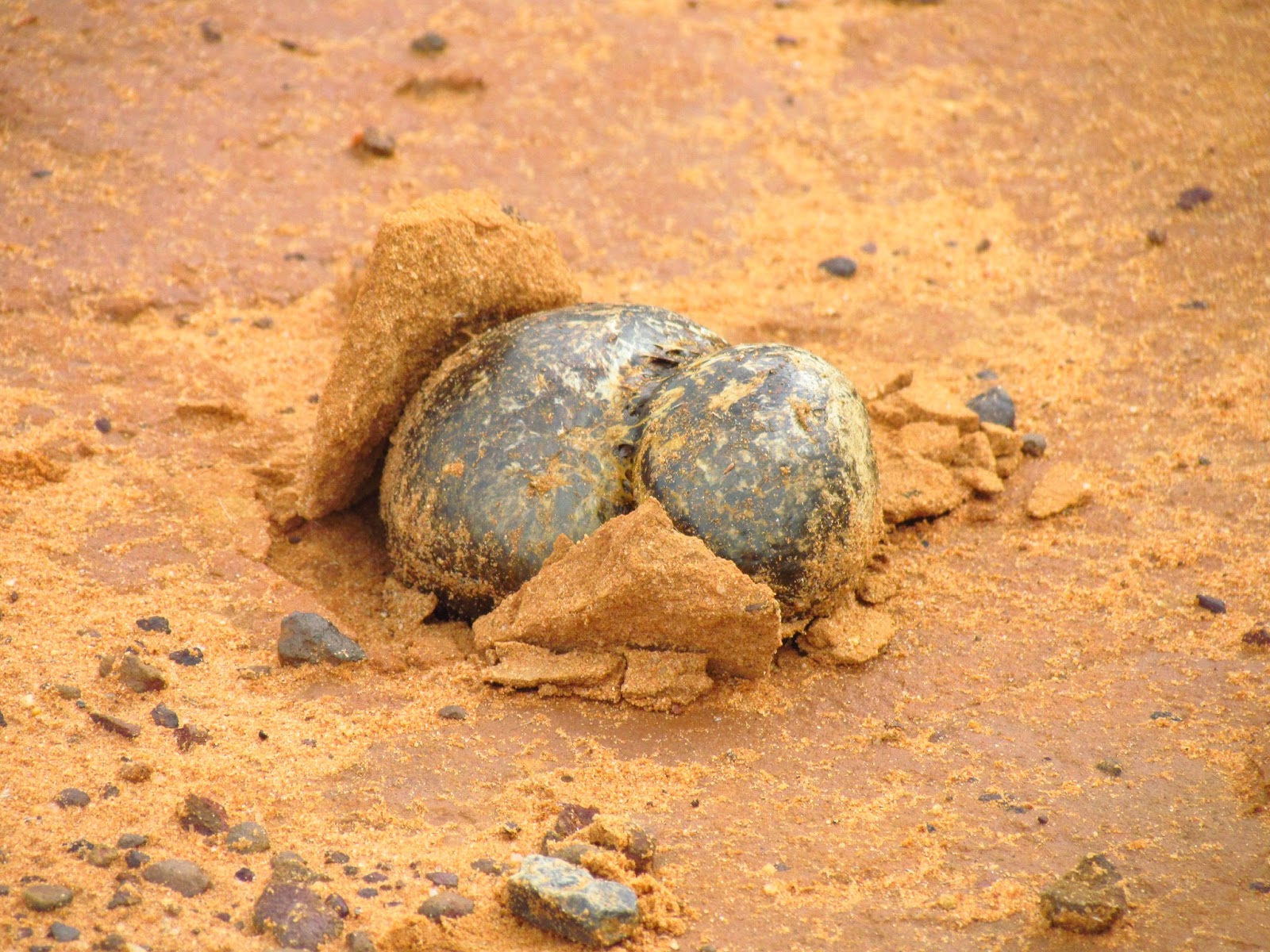 |
| Puff ball - photo by F. Mangubhai |
JULY SPEAKER'S REPORT - Bird Carer, Lorraine McPhee
Lorraine, with her many years of bird-care experience gave us a number of critically important points about what to do and not to do when trying to help birds, so I will repeat points from her ‘Fledgling Birds’ leaflet called “So You Think I Can’t Fly!”:.....
1. Can the bird you are concerned about Stand and Walk?
2. Is the bird Trying to fly?
3. Are its Parents nearby?
If it is “Yes” to these three questions, then it has just left the nest and is learning to fly. It is best to put it in the tree near where you found it. The parents are looking for it and they will continue to feed and care for it.
Birds born in tree hollows fly out of their hole....those born in a nest take up to five days to learn to fly after leaving their nest onto a limb.
If you find an injured bird, wrap a cloth around it, keep it held upright, and put it in a cardboard box, NOT a wire cage, as its wings can be caught and broken by the wires if it starts to flap around. Then take it to a Vet! If properly set and fixed in place, birds’ bones (which are hollow) do heal quickly.
When a bird flies into a window it often suffers (and will die) from a ruptured air sack, so please mark your glass windows and sliding doors with curtains, shades, and/or stickers.
When dealing with raptors, one must be especially cautious of their talons! And another caution is that Frogmouths do bite! Kookaburra and Emus will adopt new chicks that are not their own; and one can add new ducklings to join up with a flock of its own kind.
A serious virus in birds is “Beak & Feather Disease” from which about half die, and it is quite contagious between birds.
1300-Animal (1300 264 625) this is an RSPCA Qld service
Woop Woop Wildlife Rescue 0417 382 184 (In or near Toowoomba)
Report by Lauren Marlatt
18 July 2015
Some plants and fungi from Toowoomba Field Nats Club trip to Wondul Range National Park & Inglewood State Forest
Photographs and explanation by Mike and Deb Ford, ably assisted by their daughter, Lisa


 Eriocaulon sp. Possibly Eriocaulon scariosum, commonly named common, rough
or pale pipewort, a species of tufted grass-like herbaceous plants, constituting part of the plant family Eriocaulaceae. Common pipewort plants
grow naturally in wetlands, bogs and drainage areas, from central and eastern Victoria, through eastern New South Wales, including the Australian Capital Territory, to eastern and north Queensland, Australia (Wikipedia)
 .
.
Cortinarius sp. Possibly Cortinarius areolatoimbricatus. Caps to 150 mm across, deeply convex at first, becoming broadly convex and irregular at maturity. Cap surface is generally covered with overlapping fibrillose
scales. A robust, fleshy fungus usually found in dense caespitose (several fruiting bodies arising from a common base) clumps with caps distorted by mutual pressure. Common and widespread in eucalypt forest. (Bruce Fuhrer, A Field Guide to Australian Fungi, Blooming Books Pty Ltd, Melbourne, 2005.
Cryptes baccatus (Wattle Tick Scale) (Family COCCOIDAE, Soft Scale Insects) is a light bluish grey scale insect when young and turns brown with age. Forms colonies of 30-40 on some Acacias including A. melanoxylon. Tended by ants, who take away the sugary exudates. The insects live within these convex, protective "shells". Scale insects constitute a very large group of unusual plant feeding insects. This group is commonly divided into soft scales and armored scales. (Wingless and legless) adult scales spend their lives under protective shells. Soft scale insects have a waxy film secreted
over their body wall. Armored scales are protected beneath a separate cover secreted over their bodies. Some caterpillars ( e.g. Stathmopoda melanochroa) feed on various species of Scale Insect. Female scale insects
lay their eggs under their bodies or scale covers. When they first hatch, young scales have legs and are quite active. At this stage, they are called
crawlers. Crawlers disperse, locate new feeding sites, and then transform
into immobile adults. (http://www.saveourwaterwaysnow.com.au/ article by
Robert Whyte and
http://www.brisbaneinsects.com/brisbane_softbugs/WattleTickScale.htm)

Hardenbergia violacea. Hardenbergia is a small genus of three species, the most common and best known of which is Hardenbergia violacea. A widespread species occurring in Queensland, New South Wales, Victoria, Tasmania and South Australia. It occurs in a variety of habitats from coast to mountains, usually in open forest/woodland and sometimes in heath. Hardenbergia violacea is usually a climbing plant whose branches twist around the stems of other plants. It is moderately vigorous but rarely covers other plants so extensively as to cause damage. Shrubby forms without any climbing tendency
are known. The leaves are dark, glossy green with prominent veins and are 75-100 mm in length. (Australian Native Plants Society (Australia)
http://anpsa.org.au/)

Cyanicula caerulea (Eastern Tiny China Blue Orchid). Terrestrial orchid of shady forest areas in well-drained soil. Single leaf to 6 cm x 5 mm. One bluish-purple flower to 30 mm, on stem to 15 mm tall, winter to spring.
Labellum with dark bars. (Glenn Leiper, Jan Glazebrook, Denis Cox, Kerry Rathie, Mangroves to Mountains, A Field Guide to the Native Plants of South-east Queensland, Logan River Branch SGAP (Qld Region) Inc., 2008.


 Eriocaulon sp. Possibly Eriocaulon scariosum, commonly named common, rough
or pale pipewort, a species of tufted grass-like herbaceous plants, constituting part of the plant family Eriocaulaceae. Common pipewort plants
grow naturally in wetlands, bogs and drainage areas, from central and eastern Victoria, through eastern New South Wales, including the Australian Capital Territory, to eastern and north Queensland, Australia (Wikipedia)
 .
.Cortinarius sp. Possibly Cortinarius areolatoimbricatus. Caps to 150 mm across, deeply convex at first, becoming broadly convex and irregular at maturity. Cap surface is generally covered with overlapping fibrillose
scales. A robust, fleshy fungus usually found in dense caespitose (several fruiting bodies arising from a common base) clumps with caps distorted by mutual pressure. Common and widespread in eucalypt forest. (Bruce Fuhrer, A Field Guide to Australian Fungi, Blooming Books Pty Ltd, Melbourne, 2005.
Cryptes baccatus (Wattle Tick Scale) (Family COCCOIDAE, Soft Scale Insects) is a light bluish grey scale insect when young and turns brown with age. Forms colonies of 30-40 on some Acacias including A. melanoxylon. Tended by ants, who take away the sugary exudates. The insects live within these convex, protective "shells". Scale insects constitute a very large group of unusual plant feeding insects. This group is commonly divided into soft scales and armored scales. (Wingless and legless) adult scales spend their lives under protective shells. Soft scale insects have a waxy film secreted
over their body wall. Armored scales are protected beneath a separate cover secreted over their bodies. Some caterpillars ( e.g. Stathmopoda melanochroa) feed on various species of Scale Insect. Female scale insects
lay their eggs under their bodies or scale covers. When they first hatch, young scales have legs and are quite active. At this stage, they are called
crawlers. Crawlers disperse, locate new feeding sites, and then transform
into immobile adults. (http://www.saveourwaterwaysnow.com.au/ article by
Robert Whyte and
http://www.brisbaneinsects.com/brisbane_softbugs/WattleTickScale.htm)

Hardenbergia violacea. Hardenbergia is a small genus of three species, the most common and best known of which is Hardenbergia violacea. A widespread species occurring in Queensland, New South Wales, Victoria, Tasmania and South Australia. It occurs in a variety of habitats from coast to mountains, usually in open forest/woodland and sometimes in heath. Hardenbergia violacea is usually a climbing plant whose branches twist around the stems of other plants. It is moderately vigorous but rarely covers other plants so extensively as to cause damage. Shrubby forms without any climbing tendency
are known. The leaves are dark, glossy green with prominent veins and are 75-100 mm in length. (Australian Native Plants Society (Australia)
http://anpsa.org.au/)

Cyanicula caerulea (Eastern Tiny China Blue Orchid). Terrestrial orchid of shady forest areas in well-drained soil. Single leaf to 6 cm x 5 mm. One bluish-purple flower to 30 mm, on stem to 15 mm tall, winter to spring.
Labellum with dark bars. (Glenn Leiper, Jan Glazebrook, Denis Cox, Kerry Rathie, Mangroves to Mountains, A Field Guide to the Native Plants of South-east Queensland, Logan River Branch SGAP (Qld Region) Inc., 2008.

Subscribe to:
Posts (Atom)